Last updated:
The South Bank is the stretch of riverside that runs along the Thames from Westminster Bridge to Blackfriars Bridge, a near-continuous pedestrian promenade taking in some of London's most recognisable cultural landmarks. For the visitor who wants world-class art, architecture and river views within a single, walkable afternoon, this is the most rewarding strip in the city. This guide covers what to see, how to plan a walk and how to arrive.
What is the South Bank and where is it?
The South Bank is a riverside cultural district on the south side of the River Thames, running roughly from Westminster Bridge in the west to Blackfriars Bridge in the east. It sits opposite Westminster and the City, and is anchored by the Southbank Centre, the London Eye, the National Theatre and Tate Modern, all linked by a single riverside walkway.
Strictly speaking, the name refers to the arts complex around the Southbank Centre, but in everyday use it describes the whole riverside walk between the bridges. Continue east beyond Blackfriars and you reach Bankside, home to Tate Modern and Shakespeare's Globe, which most visitors treat as part of the same itinerary.
The essential sights along the river
The South Bank's headline attractions sit within a single walkable mile, each facing the river. From west to east you pass the London Eye, the Southbank Centre, the BFI and National Theatre, the OXO Tower, Tate Modern, the Millennium Bridge and Shakespeare's Globe. Few places in London pack so much culture into so short a stretch.
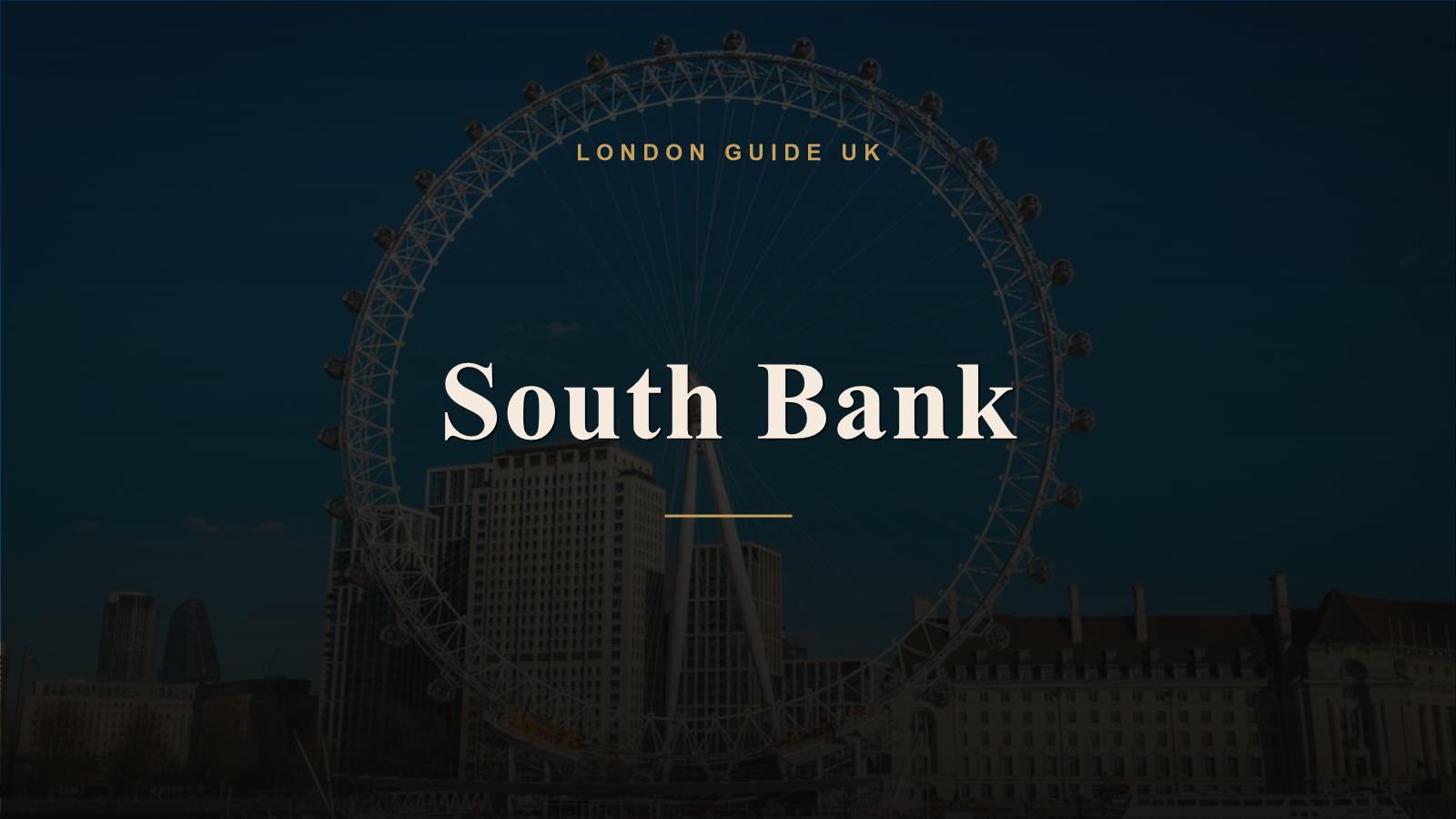
- London Eye - the giant cantilevered observation wheel beside County Hall, offering panoramic views across the city.
- Southbank Centre - the Royal Festival Hall, Queen Elizabeth Hall and Hayward Gallery, a hub of concerts, exhibitions and free foyer spaces.
- BFI Southbank and the National Theatre - the British Film Institute's repertory cinema and the brutalist concrete home of the country's flagship theatre company.
- OXO Tower - a converted Art Deco wharf building housing designer-maker studios and a free public viewing gallery.
- Tate Modern - the former Bankside Power Station, now one of the world's foremost galleries of modern and contemporary art.
- Shakespeare's Globe - a faithful reconstruction of the Elizabethan playhouse, with open-air performances in season.
Tate Modern and Bankside
Tate Modern is Britain's national gallery of international modern and contemporary art, housed in the vast former Bankside Power Station on the river. Entry to the permanent collection is free, with a programme of major paid exhibitions and large-scale commissions in the cavernous Turbine Hall. The viewing level of its Blavatnik Building extension gives sweeping views across to St Paul's.
The Millennium Bridge, the slender steel footbridge directly outside, links Tate Modern to St Paul's Cathedral across the water, making it easy to combine the South Bank with a walk into the City of London. A few steps east lies Shakespeare's Globe, and beyond it the riverside path continues towards Borough Market and London Bridge.
Walking the South Bank: a suggested route
The classic South Bank walk runs east along the riverside path, beginning at the London Eye and ending at Tate Modern and the Globe, a distance of roughly one and a half miles that takes about forty minutes at an unhurried pace. The route is flat, fully pedestrianised and stays beside the water almost the entire way.
Begin near Westminster Bridge, with views across to the Houses of Parliament and Big Ben, then follow the promenade past the London Eye and beneath Hungerford Bridge. Continue through the Southbank Centre, past the National Theatre and the OXO Tower, then on to Tate Modern and the Globe. Strong walkers can carry on to Borough Market, the Shard and London Bridge.
- Walk west to east to keep the best City and St Paul's views ahead of you.
- Allow at least half a day if you intend to go inside Tate Modern or the London Eye.
- The path is busiest at weekends and in the early evening; mornings are calmer.
- Look out for the second-hand book market under Waterloo Bridge and the undercroft skate space nearby.
Getting to the South Bank
The South Bank is served by several Underground and rail stations along its length. Waterloo is the most central, on the Jubilee, Northern, Bakerloo and Waterloo and City lines, with a short walk to the river. Westminster and Embankment sit just across the bridges, while Southwark and London Bridge serve the Tate Modern and Bankside end.
- For the London Eye and Southbank Centre: Waterloo, or Westminster and Embankment across the bridges.
- For Tate Modern and the Globe: Southwark on the Jubilee line, or Blackfriars and London Bridge.
- By river: Thames Clipper river bus services stop at the London Eye and Bankside piers, an attractive way to arrive.
- On foot: the Golden Jubilee footbridges and the Millennium Bridge connect directly to the north bank.
When to visit and what to expect
The South Bank rewards a visit in any season, but it is at its best on a clear morning or in the long light of a summer evening, when the river views are sharpest and the crowds are thinner. The promenade is open and free to walk at all hours, with the galleries, theatres and the London Eye keeping their own schedules through the day.
Expect street performers, pop-up food stalls and seasonal markets, particularly around the Southbank Centre, where a winter market and festival programming animate the riverside in the colder months. Because so much is outdoors, the walk works well in changeable weather, with Tate Modern, the National Theatre foyers and the Southbank Centre offering free indoor refuge when it rains.
South Bank FAQ
How long does the South Bank walk take?
The riverside walk from the London Eye to Tate Modern and Shakespeare's Globe covers about one and a half miles and takes roughly forty minutes at a steady pace. Allow a half day or more if you plan to go inside the galleries or ride the London Eye, as queues and exhibitions add considerable time.
Is the South Bank free to visit?
Walking the South Bank is entirely free, and the promenade is open at all times. The permanent collections at Tate Modern, the foyers and many exhibitions at the Southbank Centre, and the OXO Tower viewing gallery are also free. Paid attractions include the London Eye, special exhibitions and most theatre and concert performances.
Which Tube station is best for the South Bank?
Waterloo is the most central station for the South Bank, serving the London Eye and Southbank Centre with a short walk to the river. For the Tate Modern and Shakespeare's Globe end, Southwark on the Jubilee line or London Bridge are more convenient. Westminster and Embankment lie just across the river bridges.
What is the difference between the South Bank and Bankside?
The South Bank proper centres on the Southbank Centre arts complex between Westminster and Blackfriars bridges, while Bankside lies just to the east, around Tate Modern and Shakespeare's Globe. In practice the riverside path connects them seamlessly, and most visitors treat the two as a single continuous walk along the river.
Is the South Bank suitable for families?
Yes. The South Bank is flat, traffic-free and lined with open space, making it easy with prams and children. The London Eye, street performers, riverside food stalls and the free foyers of the Southbank Centre and Tate Modern all suit families, and there is plenty of room to pause and watch the river traffic go by.
Where to go next
Cross the Millennium Bridge to explore the City of London and St Paul's, or continue east along the river to Bermondsey for its galleries and market streets. For more riverside and central districts, browse the full collection of London neighbourhood guides.