Last updated:
Few cities reward a day trip from London as completely as Bath. In a single, walkable Georgian valley you have a UNESCO World Heritage city built around the only naturally hot springs in Britain, the finest honey-coloured stone architecture in the country, and the literary ghost of Jane Austen on every crescent. This guide is for discerning visitors who want to see the essential sights, understand what makes them significant, and return to London the same evening without feeling rushed.
How to get from London to Bath
The fastest route is the direct train from London Paddington to Bath Spa, which takes roughly an hour and a half on a good service. Trains run frequently throughout the day, making Bath one of the easiest UNESCO cities to reach from the capital for a comfortable return day trip.
From Bath Spa station it is a level walk of a few minutes into the heart of the city, so no onward transport is needed. A few practical points worth knowing before you set off:
- Booking an advance ticket online usually costs considerably less than buying on the day.
- Coaches from London Victoria are cheaper but take much longer, so the train is the better choice for a day trip.
- Bath is compact and best explored on foot, with the major sights clustered within a fifteen-minute walk of one another.
- If you prefer to drive, use a Park and Ride on the city edge rather than the congested centre.
The Roman Baths and Pump Room
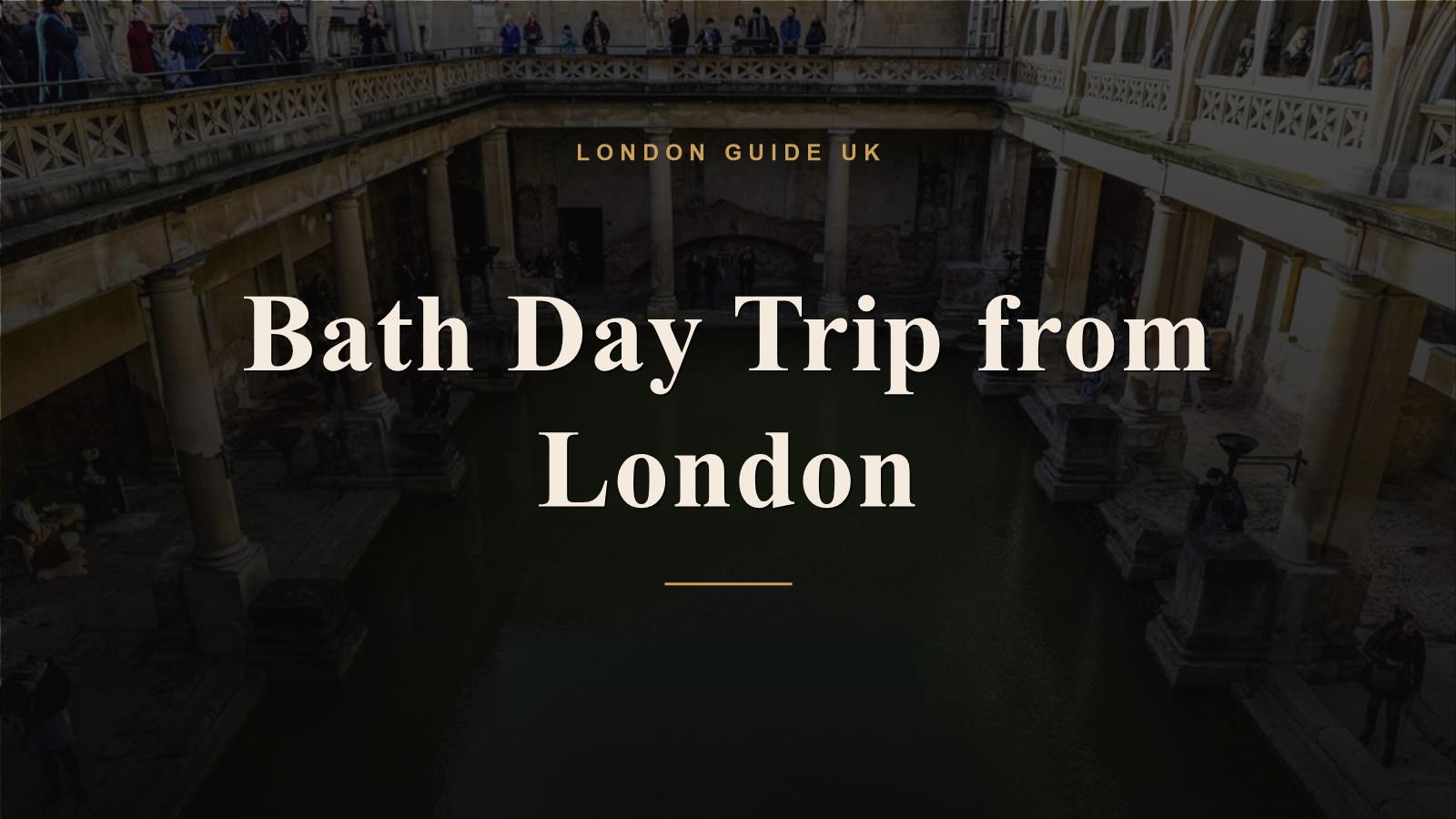
The Roman Baths are the reason the city exists and the single attraction no first-time visitor should miss. Built around the natural hot spring the Romans dedicated to the goddess Sulis Minerva, the complex preserves the steaming Great Bath, the temple foundations and a museum of remarkable finds, all below the modern street level.
Allow at least ninety minutes to do the site justice. The audio guide is genuinely worthwhile, and there is a version narrated by author Bill Bryson. Adjoining the baths is the elegant Georgian Pump Room, where you can taste the warm, mineral-rich spa water that drew fashionable society here in the eighteenth century. Buying timed tickets in advance is strongly advised, as the site is among the busiest in the country.
Georgian architecture: the Royal Crescent and the Circus
Bath's Georgian architecture is its second great glory, and the Royal Crescent is its masterpiece. This sweeping arc of thirty terraced houses, designed by John Wood the Younger and faced in golden Bath stone, is one of the most photographed streets in Europe and the defining image of Georgian town planning.
A short stroll away lies the Circus, a perfect ring of townhouses by John Wood the Elder, ringed by mature plane trees. Together they show how the city was conceived as a single architectural composition. Highlights to walk between:
- No. 1 Royal Crescent, a restored Georgian townhouse open as a museum showing how the wealthy lived.
- The Circus, whose three curved segments were inspired in part by the Colosseum turned outside in.
- Pulteney Bridge, one of the few bridges in the world lined with shops on both sides, overlooking the curving Pulteney Weir.
- The honey-coloured terraces of Lansdown and Camden, climbing the hillside above the centre.
Jane Austen and literary Bath
Bath is inseparable from Jane Austen, who lived in the city in the early nineteenth century and set much of Northanger Abbey and Persuasion here. The streets, assembly rooms and crescents she walked are largely intact, which makes the whole city a living backdrop to her novels for the literary-minded visitor.
The Jane Austen Centre on Gay Street offers an introduction to her years in Bath and the Regency world she satirised. Beyond it, simply walking past the houses where she lodged and the Assembly Rooms where Georgian society gathered brings the period vividly to life. Visitors with a deeper interest should look out for the annual Jane Austen Festival, when the city fills with Regency costume.
Bath Abbey and the city centre
Bath Abbey stands at the very centre of the city, beside the Roman Baths, and is one of the finest examples of late Perpendicular Gothic architecture in England. Its vast windows, fan-vaulted ceiling and famous carved west front, with stone angels climbing ladders to heaven, make it a rewarding stop between the major sights.
The surrounding centre is unusually pleasant to wander, with independent shops along Milsom Street, the covered Guildhall Market, and frequent views of the green hills that ring the city. If you have the energy and a clear day, the Tower Tour at the Abbey rewards you with one of the best panoramas in the West Country.
A suggested one-day itinerary
A well-paced day allows you to see Bath's essentials without hurrying. Begin with the Roman Baths before the crowds build, move up to the Georgian crescents in the late morning, break for lunch in the centre, and spend the afternoon on the Abbey and a riverside walk before catching an early-evening train back to Paddington.
- Morning: Roman Baths and Pump Room, then Bath Abbey next door.
- Late morning: walk up to the Circus, the Royal Crescent and No. 1 Royal Crescent.
- Lunch: the city centre around Milsom Street and the Guildhall Market.
- Afternoon: the Jane Austen Centre, Pulteney Bridge and a stroll along the River Avon.
For ideas on structuring other excursions like this one, the Day Trips from London hub and our London itineraries are good starting points.
Bath Day Trip from London FAQ
Is Bath worth a day trip from London?
Yes. Bath is one of the most rewarding day trips from London, combining a major Roman site, world-class Georgian architecture and a compact, walkable centre. With a train journey of around ninety minutes each way, you can see the essential sights comfortably and still return to the capital the same evening.
How long do you need in Bath?
A full day is enough to see the highlights, namely the Roman Baths, Bath Abbey, the Royal Crescent and the Circus, with time for lunch and a riverside walk. If you want to add several museums or the surrounding countryside, an overnight stay lets you explore at a far gentler pace.
Can you swim in the Roman Baths?
No, bathing in the ancient Roman Baths themselves is not permitted, as they are a preserved historic monument. Visitors who wish to bathe in Bath's natural thermal waters can do so at the separate modern spa nearby, which draws on the same hot springs that made the city famous.
Which London station has trains to Bath?
Direct trains to Bath Spa depart from London Paddington, in the west of the city. Paddington is served by the Bakerloo, Circle, District and Hammersmith and City Underground lines, as well as the Elizabeth line, so it is easy to reach from most central London neighbourhoods.
Should you book tickets in advance?
Yes, for both. Advance train tickets are usually much cheaper than buying on the day, and the Roman Baths use timed entry that frequently sells out at busy periods. Booking both before you travel guarantees your slot and tends to give you the best value for a single day trip.
Where to go next
If Bath has whetted your appetite for England beyond the capital, explore more of the best day trips from London. For a contrast, the historic university cities of Oxford and Cambridge are equally rich in architecture, while Windsor offers royal grandeur within a much shorter journey.