Last updated:
The Barbican is one of London's most uncompromising statements in concrete, a vast residential and cultural estate built on land flattened by wartime bombing and reimagined as a city within the City. For the discerning visitor it offers two distinct rewards: a masterclass in post-war Brutalist architecture, and the Barbican Centre, the largest performing arts complex in Europe. This guide is for travellers who want to understand the place rather than simply pass through it, and who appreciate culture, design and quiet ambition over the obvious.
Why visit the Barbican
The Barbican is worth visiting for its rare combination of bold Brutalist architecture and a world-class arts centre under one estate. It draws design enthusiasts, concert-goers, theatre audiences and curious wanderers who want a side of London that feels deliberate, monumental and entirely unlike the city's older quarters. It rewards slow, attentive exploration.
Built between the 1960s and the early 1980s on a site devastated during the Blitz, the estate was conceived by the architects Chamberlin, Powell and Bon as a complete neighbourhood with flats, gardens, schools and a cultural hub. It is now Grade II listed, recognised as one of the most significant examples of Brutalism in Britain. Whether you find the raw concrete forbidding or magnificent, the ambition is undeniable.
The architecture and estate
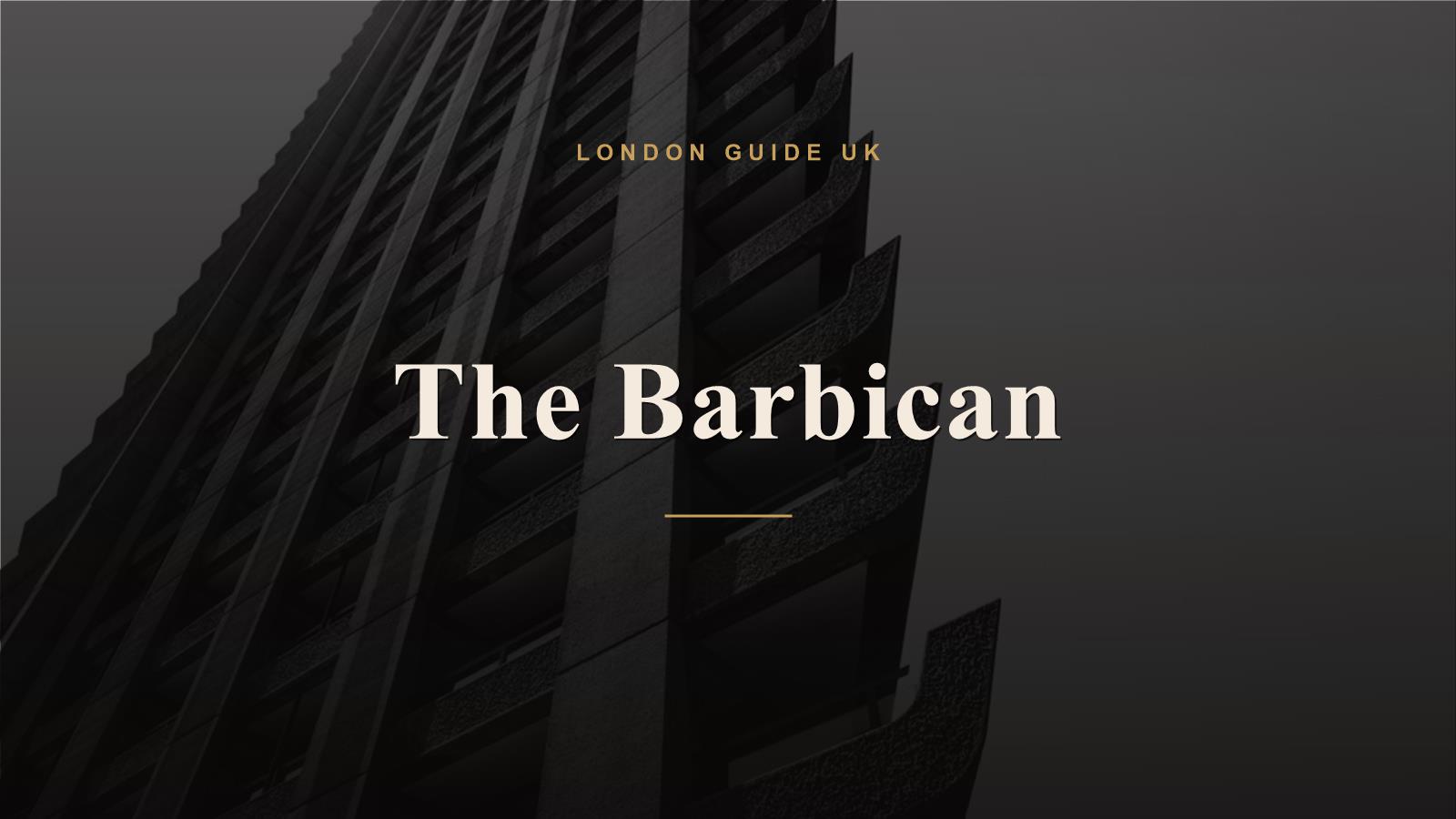
The Barbican Estate is a Grade II listed Brutalist housing development of around two thousand flats arranged across terraces and three landmark towers, set among raised walkways, lakes and planted gardens. Its bush-hammered concrete, geometric repetition and elevated pedestrian decks make it a defining work of British post-war urban design and a destination in its own right.
The three towers, named Cromwell Tower, Lauderdale Tower and Shakespeare Tower, were among the tallest residential buildings in London when completed. At ground and podium level the estate unfolds as a sequence of courtyards, water features and surprising green corners. Plan to walk slowly and look up.
- Follow the painted yellow line on the walkways, a navigation aid that guides visitors through the deliberately maze-like estate.
- Find the lakeside terrace, where water, planting and concrete come together at their most photogenic.
- Look for St Giles' Cripplegate, a medieval church that survived the bombing and now sits, startlingly, among the modern blocks.
The Barbican Centre
The Barbican Centre is Europe's largest multi-arts venue, bringing together a concert hall, two theatres, cinemas, an art gallery and a public library within a single complex. It is the resident home of the London Symphony Orchestra and presents an ambitious international programme of classical music, theatre, dance, film and contemporary visual art throughout the year.
The Centre's interior is a labyrinth of levels and foyers that rewards exploration. Even without a ticket you can wander the public spaces, browse exhibitions in the foyers and settle into one of London's more atmospheric cultural meeting points. For a full sense of London's wider cultural offer, see our guide to the best things to do in London.
- The Barbican Hall hosts orchestral concerts, jazz and contemporary music.
- The Barbican Art Gallery and The Curve present major exhibitions in art, design and architecture.
- The cinemas screen everything from new releases to festivals and classic seasons.
The Conservatory
The Barbican Conservatory is a tropical glasshouse tucked above the theatre fly tower, home to thousands of plants and trees alongside fish and terrapins. It is the second largest conservatory in London after Kew and one of the city's most unexpected sights, a lush green interior wrapped in the same Brutalist concrete that defines the estate outside.
The Conservatory typically opens to the public on selected days, so it is wise to check the Barbican's official schedule before you plan a visit. The contrast between jungle planting and raw concrete is the single most memorable image many visitors take away, and it is free to enter when open.
Getting there and getting around
The Barbican is reached most directly via Barbican station on the Circle, Hammersmith and City, and Metropolitan lines, with Moorgate and St Paul's stations also within a short walk. The estate sits in the north of the City of London, well connected by Underground and bus, and best navigated on foot once you arrive via its elevated walkways.
- Barbican station serves the Circle, Hammersmith and City, and Metropolitan lines.
- Moorgate and Liverpool Street connect to the Elizabeth line and national rail for arrivals from further afield.
- St Paul's on the Central line offers an easy approach combined with the cathedral.
- Allow extra time, as the highwalk layout can be disorientating on a first visit.
What to combine with a visit
A Barbican visit pairs naturally with the surrounding City of London, where the medieval street pattern, Roman remains and gleaming modern towers sit side by side. Within a short walk you will find the Museum of London's former home, the Guildhall, and the financial district, making it easy to build a half-day or full-day cultural itinerary around the estate.
- Explore the wider City of London for history, architecture and the Square Mile's contrasts.
- Walk south to St Paul's Cathedral and the river within fifteen minutes.
- Continue east toward Tower Hill and St Katharine Docks for the Tower of London and a handsome marina.
The Barbican FAQ
Is the Barbican free to visit?
Yes, exploring the Barbican Estate, its walkways, gardens and the public foyers of the Barbican Centre is free. The Conservatory is also free when open. Tickets are needed only for concerts, theatre, cinema screenings and the main ticketed exhibitions in the art gallery and The Curve.
What architectural style is the Barbican?
The Barbican is a leading example of Brutalism, a post-war movement defined by exposed, board-marked or bush-hammered concrete, bold geometric forms and honest structural expression. Designed by Chamberlin, Powell and Bon and now Grade II listed, it is widely regarded as one of the most important Brutalist developments in the United Kingdom.
How long should I spend at the Barbican?
Allow at least two hours to walk the estate, see the lakeside and visit the foyers and any open exhibition. If you add the Conservatory, a gallery show or stay for a performance, the Barbican easily fills half a day or more, especially when combined with the surrounding City of London.
Can you visit the Conservatory?
Yes, but the Conservatory opens to the public only on selected days, so always check the Barbican's official schedule before travelling. When open it is free to enter. The combination of tropical planting, ponds and surrounding concrete makes it one of London's most distinctive and quietly surprising indoor spaces.
Is the Barbican good for photography?
Yes, the Barbican is among London's most rewarding subjects for architectural photography. The repeating concrete forms, elevated walkways, reflecting lakes and the contrast between the towers and St Giles' Cripplegate offer striking compositions. Soft, overcast light flatters the textured concrete, and early mornings bring calmer, less crowded conditions.
Where to go next
Continue your reading with our wider London neighbourhoods guides, dive deeper into the surrounding City of London, or head east to Tower Hill and St Katharine Docks for the river and the Tower of London.