Last updated:
Westminster is the ceremonial and political heart of London, the stretch of riverside between Whitehall and the Thames where the monarchy, Parliament and the established Church have stood side by side for a thousand years. For the discerning visitor it offers the city at its most monumental: a compact district where you can walk from a royal abbey to the seat of government in minutes. This guide covers what to see, how to plan a visit and how to move through Westminster without surrendering to the crowds.
Why Westminster matters
Westminster is the historic centre of English and British power, home to the Houses of Parliament, Westminster Abbey and a cluster of government buildings along Whitehall. It is where monarchs are crowned, prime ministers govern and the nation marks its great occasions. For visitors it concentrates more of Britain's national story into a few hundred metres than anywhere else in the country.
The area takes its name from the abbey, the "west minster" that gave the surrounding settlement its identity long before the modern city grew up around it. Today the name covers both this dense ceremonial core and the wider City of Westminster, a borough that reaches up through the West End. Most visitors mean the former: the riverside between Westminster Bridge and Parliament Square.
The Palace of Westminster and Big Ben
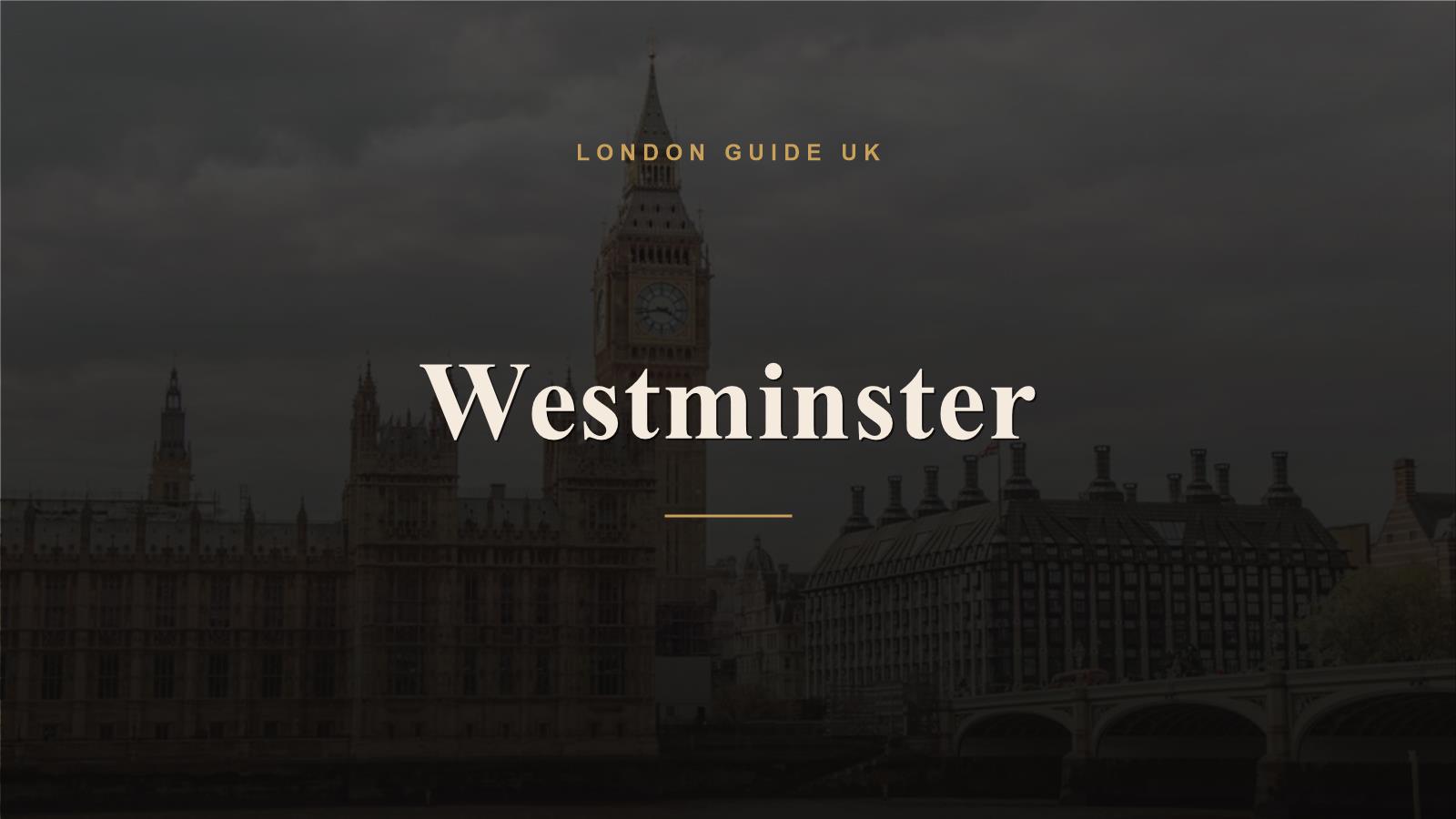
The Palace of Westminster, better known as the Houses of Parliament, is the meeting place of the House of Commons and the House of Lords, rebuilt in Gothic Revival style after a fire in 1834. Its most famous feature is the clock tower, officially the Elizabeth Tower, whose great bell Big Ben gives the whole structure its popular name.
The riverside facade is best seen from across the Thames or from Westminster Bridge, where the tower lines up with the water. The public can attend debates in both chambers and, when Parliament is sitting, watch proceedings from the galleries. Guided tours of the building run on selected days and offer access to Westminster Hall, the medieval survivor of the older palace.
- View the towers from the South Bank end of Westminster Bridge for the classic photograph.
- Westminster Hall, dating from the late eleventh century, is the oldest part and has hosted coronation banquets and lyings-in-state.
- Check whether the Commons or Lords is sitting if you hope to watch a debate.
Westminster Abbey
Westminster Abbey is the great Gothic church where English and British monarchs have been crowned since 1066 and where many are buried. It is also the resting place of statesmen, scientists and poets, with Poets' Corner honouring writers from Chaucer onwards. A working church rather than a cathedral, it remains central to royal weddings, funerals and national services.
Allow plenty of time inside. The nave, the royal tombs, the Lady Chapel of Henry VII with its fan-vaulted ceiling, and the Coronation Chair all reward unhurried attention. The Queen's Diamond Jubilee Galleries, set high in the medieval triforium, give a rare view down into the abbey and display treasures rarely seen at ground level.
- Poets' Corner, with memorials to Chaucer, Dickens, Hardy and many others.
- The tomb of the Unknown Warrior near the west door.
- The Cloisters and College Garden, among the oldest cultivated gardens in England.
Whitehall and the corridors of power
Whitehall is the broad avenue running north from Parliament Square to Trafalgar Square, lined with the government departments that run the country. Along it stand Downing Street, the prime minister's residence behind its security gates, the Cenotaph war memorial and Horse Guards, where mounted sentries of the Household Cavalry keep watch.
This is a walking route as much as a destination. The Cenotaph, designed by Edwin Lutyens, is the focus of the nation's Remembrance Sunday service each November. At Horse Guards you can watch the changing of the mounted guard, and the parade ground behind hosts Trooping the Colour in summer. Beneath Whitehall, the Churchill War Rooms preserve the underground bunker from which Britain was directed during the Second World War.
St James's Park and the royal approach
St James's Park is the oldest of London's royal parks, a graceful expanse of lake, lawns and pelicans linking Westminster to Buckingham Palace. Its central bridge offers one of the city's finest views, with the palace at one end and the domes and turrets of Whitehall rising beyond the water at the other. It is the natural green link in any Westminster itinerary.
From the park, the ceremonial avenue of The Mall leads to Buckingham Palace, the monarch's official London residence and the setting for the changing of the guard. The State Rooms open to the public in late summer. Nearby, Tate Britain sits on Millbank along the river, holding the national collection of British art from the Tudors to the present, including the world's greatest gathering of work by J.M.W. Turner.
Getting there and getting around
Westminster Underground station sits at the foot of the Elizabeth Tower and is served by the Jubilee, Circle and District lines, putting you within a minute's walk of Parliament and the abbey. St James's Park and Victoria stations serve the western side of the district, and the riverboat piers at Westminster connect the area to Greenwich and the Tower by Thames Clipper.
- Underground: Westminster (Jubilee, Circle, District); St James's Park (Circle, District).
- River: Westminster Pier for services downriver to Greenwich and upriver to Kew.
- On foot: Parliament, the abbey, Whitehall and St James's Park form a compact loop walkable in a morning.
- Arrive early to see the abbey and Parliament before the heaviest crowds build through the day.
Westminster FAQ
How long should I spend in Westminster?
Allow at least half a day, and a full day if you want to go inside Westminster Abbey, tour Parliament and visit the Churchill War Rooms. The outdoor sights, including Parliament Square, Whitehall and St James's Park, can be walked comfortably in two to three hours at an unhurried pace.
Can I go inside the Houses of Parliament?
Yes. The public can watch debates in the Commons and Lords from the galleries when Parliament is sitting, and guided and audio tours run on selected days, usually Saturdays and during recess. UK residents can also arrange visits through their Member of Parliament. Book tours in advance to secure a place.
Is Westminster Abbey free to visit?
Sightseeing visits to Westminster Abbey require a paid ticket, best booked online in advance to avoid queues. There is no charge to attend a service of worship, such as Evensong, which also lets you experience the building and its choir, though sightseeing is not permitted during services.
Where is the best view of Big Ben?
The classic view is from the eastern end of Westminster Bridge or the South Bank opposite, where the Elizabeth Tower rises beside the river. Parliament Square and the approach along Whitehall offer good angles too, and St James's Park bridge gives a striking distant view across the lake.
What is the difference between Westminster the area and the City of Westminster?
Westminster the area is the small ceremonial core around Parliament and the abbey. The City of Westminster is a much larger London borough that also takes in Mayfair, Soho, Marylebone and much of the West End. Most visitors using the name mean the historic core by the river.
Where to go next
Continue exploring with our London neighbourhoods guide, then trace the river east to the City of London, the financial square mile with its own thousand years of history. For the Tower of London and the riverside beyond, see our guide to Tower Hill and St Katharine Docks.