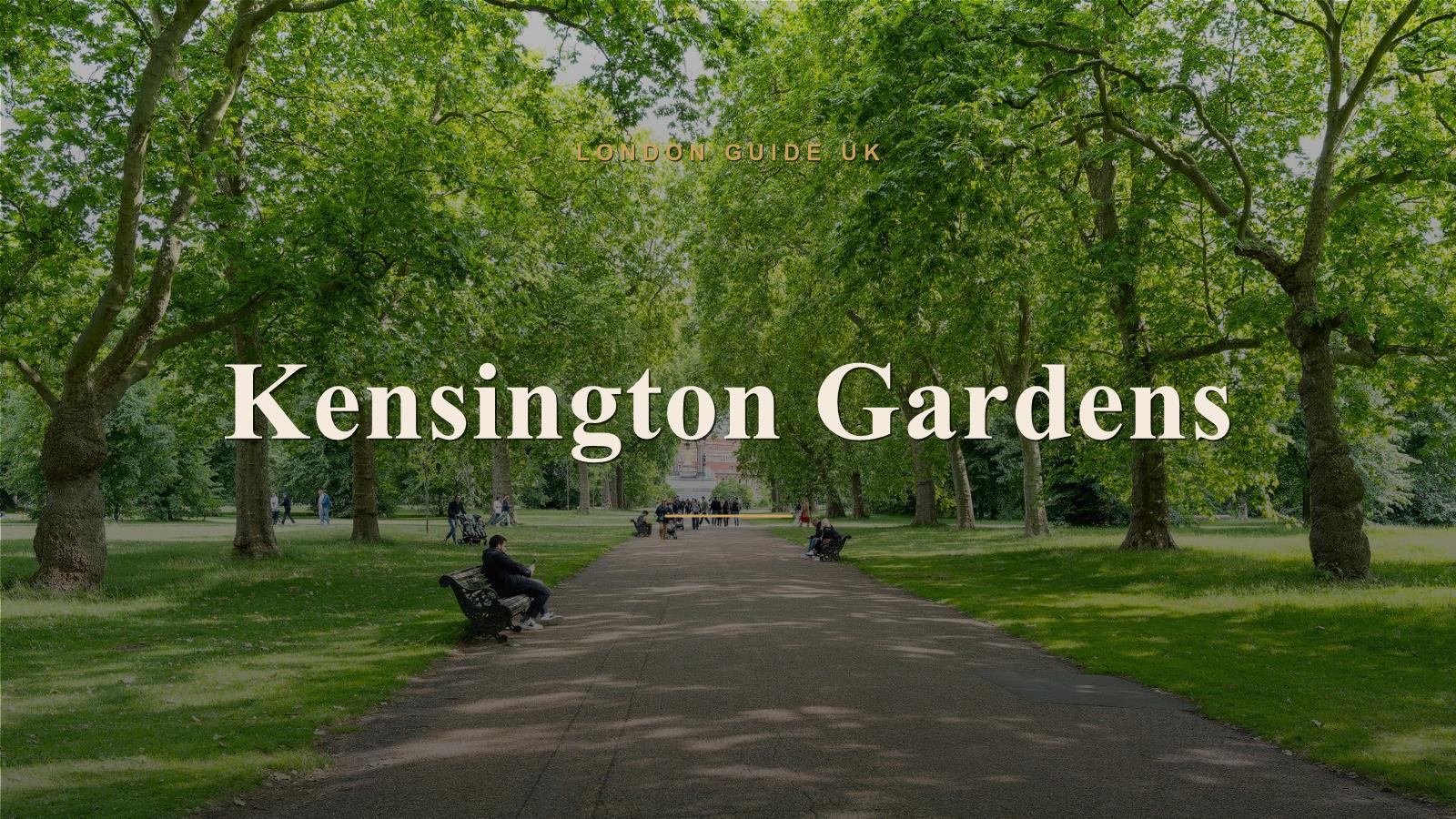
Kensington Gardens is one of London's eight Royal Parks, a serene expanse of formal avenues, ornamental water and open lawn occupying the western half of the great green belt that runs through the heart of the capital. Once the private grounds of Kensington Palace, it sits immediately west of Hyde Park, the two divided only by the West Carriage Drive and the slim lake known as the Long Water. For the visitor it offers a calmer, more cultivated counterpoint to its busier neighbour, with statuary, fountains and a royal residence set among some of the finest planting in central London.
Why visit Kensington Gardens
Kensington Gardens rewards visitors with a rare combination of royal heritage, formal landscape and quiet beauty, all within easy reach of South Kensington's great museums. It is the place to see Kensington Palace, the ornate Italian Gardens, the gilded Albert Memorial and the famous Peter Pan statue, set among broad tree lined avenues that feel a world away from the surrounding city. The gardens reward the unhurried walker. Laid out in the eighteenth century with the formal precision of the period, their straight avenues radiate from the Round Pond and draw the eye towards distant landmarks. Mature limes, oaks and chestnuts line the paths, and the planting around the palace and the flower walk is among the most carefully tended in the city. Whether you come for the architecture, the history or simply a restorative stroll, the gardens offer a sense of space and grace that is hard to find elsewhere in central London.
What to see in Kensington Gardens
The gardens are compact enough to explore on foot in a single visit, yet rich in set pieces. The highlights below repay a slower pace.
- Kensington Palace, a working royal residence and historic state apartments, the birthplace of Queen Victoria and long associated with the present Royal Family.
- The Italian Gardens, an ornamental water garden of fountains, urns and a pavilion at the northern end, created in the Victorian era.
- The Albert Memorial, the soaring gilded Gothic monument facing the Royal Albert Hall, commissioned in memory of Prince Albert.
- The Peter Pan statue, a beloved bronze on the bank of the Long Water, marking the spot from J. M. Barrie's stories.
- The Diana, Princess of Wales Memorial Playground, an imaginative space for children with a pirate ship at its heart.
- The Round Pond, the formal pool before the palace, a favourite for model boats and birdwatching.
- The Serpentine Galleries, two free contemporary art spaces, including the celebrated annual Serpentine Pavilion.
- The Sunken Garden and flower walk near the palace, at their most colourful in the warmer months.
How to visit Kensington Gardens
Kensington Gardens lies in the Royal Borough of Kensington and Chelsea, bordered by Kensington Road to the south, Bayswater Road to the north and Kensington Palace to the west. The nearest Underground stations are Queensway and Bayswater on the Central and Circle and District lines for the northern entrances, Lancaster Gate on the Central line for the Italian Gardens, and High Street Kensington on the Circle and District lines for the palace and the southern paths. South Kensington, served by the Piccadilly, Circle and District lines, is a short walk from the Albert Memorial. Entry to the gardens is free and they are open to the public daily. Admission to Kensington Palace and the state apartments is ticketed, and the Serpentine Galleries are free to enter. Opening hours vary by season and the palace closes at certain times, so visitors should check the official Royal Parks and Historic Royal Palaces websites for current tickets, times and any event closures before setting out.
What's nearby
The gardens sit at the centre of one of London's richest clusters of culture and sightseeing. Immediately to the east, Hyde Park continues the green expanse towards Speakers' Corner and the Serpentine lido. To the south, across Kensington Road, lies the museum quarter of South Kensington, home to the Victoria and Albert Museum, the Natural History Museum and the Science Museum, while the Royal Albert Hall stands opposite the Albert Memorial. To the west, the elegant streets of Kensington and the shops of High Street Kensington are within easy reach, and Notting Hill and the Portobello Road market lie a short distance to the north. Our guide to London's museums and galleries and to its distinctive neighbourhoods can help you plan the wider area.
Kensington Gardens FAQ
Is Kensington Gardens free to enter?
Yes. Kensington Gardens is a Royal Park and free to enter every day, with no admission charge for the grounds, the Italian Gardens, the Round Pond or the statues. Kensington Palace and its state apartments require a ticket, while the two Serpentine Galleries are free. Check the official websites for current palace prices and times.
What is the difference between Kensington Gardens and Hyde Park?
The two parks adjoin to form one continuous green space, divided by the West Carriage Drive and the Long Water. Kensington Gardens, the western half, is the more formal and ornamental, with avenues, fountains and Kensington Palace. Hyde Park, to the east, is larger and livelier, known for the Serpentine, Speakers' Corner and major events.
Which Underground station is closest to Kensington Gardens?
It depends which corner you want. Queensway and Bayswater serve the northern entrances, Lancaster Gate is closest to the Italian Gardens, and High Street Kensington and South Kensington give easy access to the palace and the Albert Memorial. All are within a short walk, so choose the station nearest the part of the gardens you intend to see first.
Can you visit Kensington Palace inside the gardens?
Yes. Kensington Palace stands within the gardens and parts of it are open to the public as a visitor attraction, including the state apartments and changing exhibitions. It remains a working royal residence, so access is ticketed and certain areas are private. Book ahead and confirm opening times on the official Historic Royal Palaces website.
Plan your visit
Kensington Gardens pairs naturally with a wider day in west London. Browse more of the capital's landmarks in our guide to London's attractions, explore the world class collections nearby on our museums and galleries page, and find ideas for filling the rest of the day among the best things to do in London.